
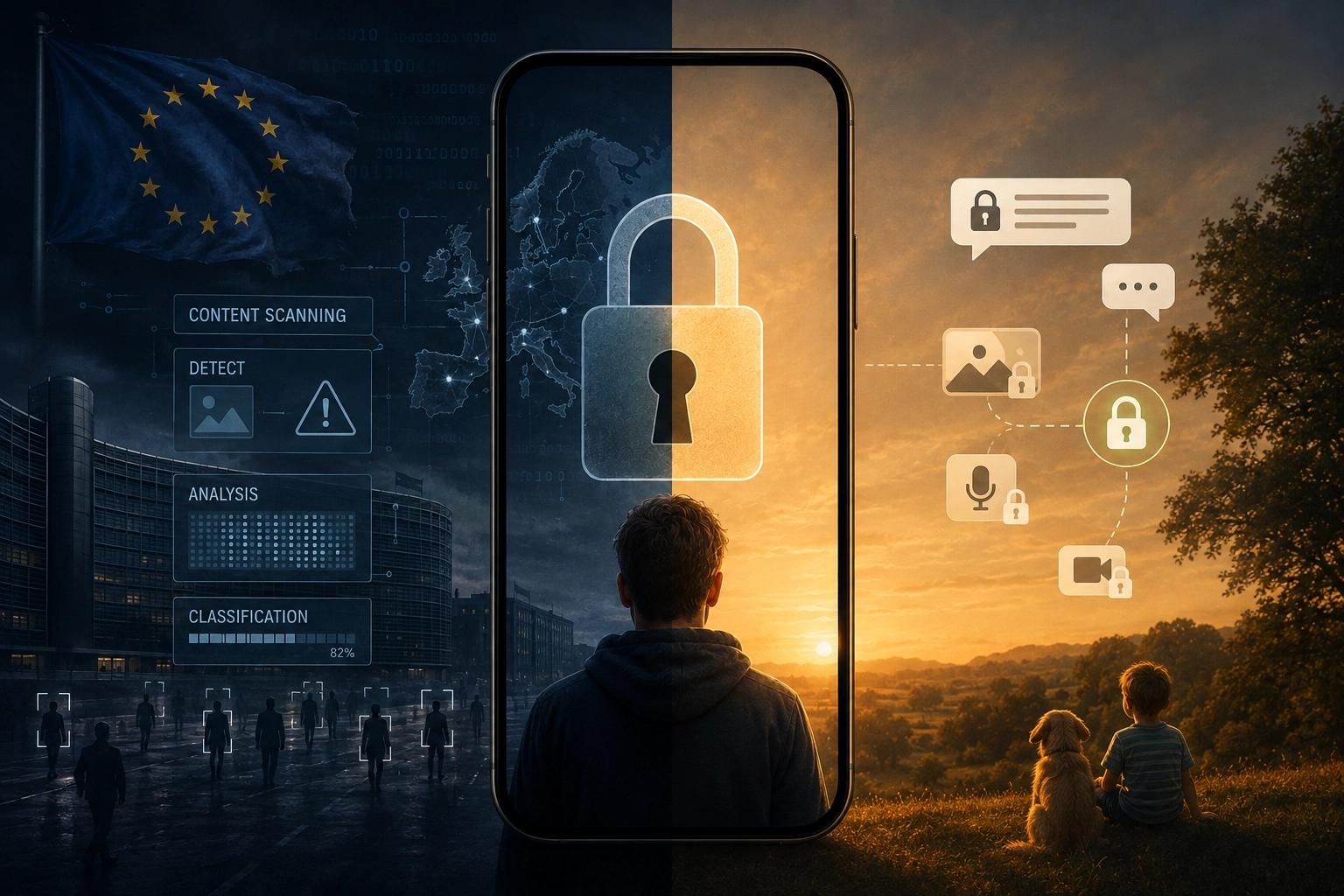
There are few political goals easier to agree with than stopping the sexual abuse of children.
That's also what makes the discussion around so-called chat control difficult.
If you object to scanning private communication, it's easy to make it sound like you're objecting to the stated goal. You're not. The interesting question is what technical and legal mechanisms we're willing to build to achieve that goal, and what happens once those mechanisms exist.
What chat control actually refers to
"Chat control" isn't the official name of a law. It's a term commonly used for EU proposals and rules concerning the detection of child sexual abuse material, usually shortened to CSAM, in online services and private communications.
The details matter because there have been several proposals, compromises and temporary rules. Treating all of them as one fixed proposal isn't accurate.
As of August 2026, the EU has reinstated temporary rules that allow service providers to voluntarily detect, report and remove child sexual abuse material. Those temporary rules apply until 3 April 2028. The version adopted in July 2026 excludes interpersonal communications where end-to-end encryption is, has been or will be applied.
The permanent legislation is a separate matter and is still being negotiated. The Council's current position would require services to assess and mitigate risks and would make voluntary detection permanent. The European Parliament adopted its own position in 2023, including explicit protections for end-to-end encryption.
So saying that "the EU has passed chat control and will scan every encrypted message" isn't an accurate description of the current situation.
But that doesn't make the underlying question go away.
Encryption isn't the interesting part
A lot of the debate gets reduced to whether end-to-end encryption will be broken.
That's too narrow.
End-to-end encryption means the service carrying a message doesn't have the keys required to read its contents. The message is encrypted on one endpoint and decrypted on another.
You can keep that encryption mathematically intact and still inspect the message.
You just inspect it before encryption or after decryption.
This is why client-side scanning matters. If software on my phone examines a photo before it's encrypted, the transport can still truthfully be described as end-to-end encrypted. The content was simply inspected at one of the ends.
That's an important distinction technically. It's a much less comforting distinction if what you care about is whether your private communication can be inspected.
The endpoint becomes part of the surveillance system
Modern encrypted messaging works partly because we treat endpoints differently from the network between them.
The network shouldn't need to know what I'm saying. The server shouldn't need to know what I'm saying. My device and the recipient's device do.
If content analysis is moved onto the endpoint, that model changes.
The device is no longer just acting on behalf of its owner. It can also be required to evaluate the owner's communication against rules defined somewhere else.
That distinction is more important to me than whether someone can technically claim that the encryption algorithm remains untouched.
If my phone checks a message before encrypting it and can cause that message, an identifier or some other information to be reported, then the confidentiality of the communication depends on the scanner as well as the encryption.
The encryption can be perfect. The system can still inspect the plaintext.
Scanning has to answer an awkward question
How does a machine know what it's looking for?
Known illegal files can be identified using hashes or related matching systems. That's relatively constrained. You have known material and you're trying to find copies or sufficiently similar versions of it.
Detecting previously unknown material is a different problem.
Detecting grooming is different again.
Now you're no longer comparing a file against a known identifier. You're classifying content or behaviour.
Classification isn't certainty.
There will be thresholds. There will be false positives. There will be false negatives. Someone has to decide what gets classified, what happens when something matches and what information leaves the device or service.
Those aren't implementation details. They're the system.
At scale, small error rates aren't small
Suppose a detection system is extremely accurate.
That sounds good until you apply it to billions of messages, images and videos.
Even a very low false-positive rate can produce a significant number of incorrect matches when the input volume is enormous.
The exact impact depends on the detection method, error rate, prevalence of the material being detected and what happens after a match. Those numbers can't be honestly invented, so I'm not going to put fake precision here.
But the underlying problem is basic statistics.
At internet scale, "almost always correct" and "only occasionally wrong" need actual numbers attached to them.
The scope is the long-term problem
A system designed to detect one category of content is still a system for inspecting content.
That's where the implication becomes larger than the original purpose.
If the infrastructure exists, changing what it searches for may be much easier than building the infrastructure in the first place.
Today the argument is child sexual abuse material. That's an exceptionally strong justification because the material is both illegal and directly tied to serious harm.
But software doesn't understand political promises.
A scanning component receives rules, evaluates data and produces a result. If its rules can be updated, its detection scope can potentially be updated too.
Whether future expansion would be legal is a separate question. Technically, you've already crossed the expensive boundary by creating a mechanism capable of inspecting private content.
It also creates a security target
Any mechanism capable of inspecting private communication becomes interesting to attackers.
That includes criminals, hostile governments and anyone else who would like access to information that encryption was supposed to protect.
The exact attack surface depends on the implementation. A local hash-matching system isn't identical to a machine-learning classifier, and neither is identical to uploading content for server-side analysis.
But additional privileged processing of private content means additional code, data and trust relationships that need to be secured.
Security engineering usually tries to reduce those things.
We remove unnecessary privileges. We minimise collected data. We limit who has access. We try to make sensitive information technically inaccessible instead of writing a policy saying nobody should look at it.
Strong end-to-end encryption follows that principle nicely.
The server can't leak plaintext it never had.
This isn't only about criminals
There's another recurring argument: ordinary people have nothing to worry about because the system is looking for illegal material.
That's not how privacy works.
I don't encrypt a password because it's illegal. I don't expect a private conversation with my family to remain private because we're committing crimes. Companies don't protect trade secrets because the contents are embarrassing.
Confidentiality has value on its own.
Private communication is used by journalists, lawyers, doctors, businesses, governments, security researchers and ordinary people discussing ordinary things.
A communication system can't know in advance which private messages deserve privacy. That's why encryption protects the channel rather than making a moral judgement about every message passing through it.
The precedent matters more than the first implementation
The current EU debate has changed substantially since the Commission presented its original proposal in 2022. The European Parliament has pushed for stronger protection of encrypted communication, and the temporary rules adopted in 2026 explicitly exclude end-to-end encrypted interpersonal communication.
That's worth being precise about.
It's also worth watching what happens to the permanent framework.
The important boundary isn't a particular scanning algorithm. It's whether private communication remains something authorities must target through conventional investigative processes, or whether communication platforms and devices become part of a general detection layer.
Those are very different architectures.
One starts with private communication and creates exceptions when there's sufficient reason to investigate someone.
The other starts by making inspection technically available and then relies on rules to limit when and why it's used.
I know which design I'd rather secure.
There isn't a magic technical compromise
It's tempting to describe this as a problem waiting for sufficiently clever technology.
Maybe we can scan everything without anyone being able to misuse the scanner. Maybe we can inspect plaintext without weakening confidentiality. Maybe a sufficiently accurate classifier removes the false-positive problem.
Those claims need scrutiny, not optimism.
If a system can determine whether my private content matches some externally defined condition, information about my private content is being processed for somebody else's purpose.
You can minimise what gets exposed. You can add cryptography. You can require warrants or independent approval. You can restrict which content can be detected. Those safeguards can make an enormous difference.
They don't make the underlying capability disappear.
That's the implication of chat control that matters to me.
The question isn't whether protecting children is important. It obviously is.
The question is whether we should build communication systems around the assumption that private messages may need to be inspected.
Once that becomes part of the architecture, "private" means something different.